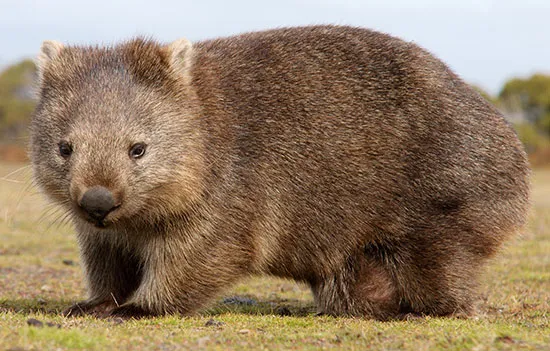
The digger
A twenty-five kilo animal that digs thirty-metre tunnels, has an armoured backside and produces cube-shaped droppings. It resembles nothing else.
Wombats (Vombatidae) are Australian marsupials. They are muscular short-legged quadrupeds about a metre long, counting a very short tail. The name wombat comes from the Eora, the Aboriginal community who were the original inhabitants of the Sydney area. They live in the wooded, mountainous and heath areas of south-east Australia and Tasmania.
Its pouch faces backwards, so that digging does not fill it with earth, and its rump is made of cartilage: when a predator chases it into the burrow, it blocks the entrance with its backside 1.
| Species | Scientific name | Status |
|---|---|---|
| Common wombat | Vombatus ursinus | Least concern |
| Southern hairy-nosed wombat | Lasiorhinus latifrons | Near threatened |
| Northern hairy-nosed wombat | Lasiorhinus krefftii | Critically endangered |
Little more than three hundred northern hairy-nosed wombats are left, all of them in two fenced reserves in Queensland. It is one of the rarest mammals in the world.
1 The rump is so hard that a predator chasing it inside the tunnel can do nothing about it.